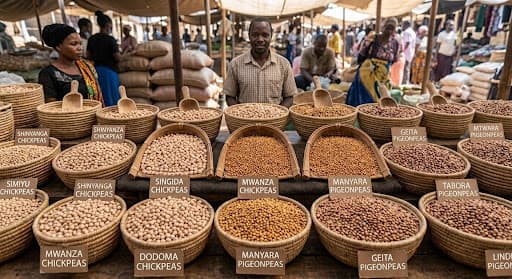
Tanzania Pulses Market Gains Momentum as Chickpea and Pigeon Pea Harvests Accelerate
6 Sep 2026
Market Overview
Tanzania's 2026 pulses marketing season is progressing at a different pace from last year, with some crops entering the market later than initially expected. Delays in rainfall during the planting period contributed to a slower start to harvesting in some production areas.
As the season advances, however, market activity is gaining momentum. Pigeon peas and
Chickpeas are currently accounting for the largest share of pulse volumes entering the
market, while green grams are also being harvested.
Despite the slow start, data gathered from auctions hosted by the Tanzania Mercantile
Exchange (TMX)—the government-approved platform for commodities trading—shows steady progress across major crops. While harvesting spans Pigeonpeas, Chickpeas, and Green grams,Chickpeas and Pigeonpeas currently hold the vast majority of market share.
Chickpeas: Production Rankings and Price Disparities
National Chickpea production usually peaks in September, placing current trade totals at
roughly 40,000 tons.
Singida has emerged as a major Chickpea powerhouse, recording over 10,000 tons sold by early August. Itigi district – which historically accounts for roughly 20% of national production –drove the region's volume. Despite strong supply, prices in Singida were underwhelming, averaging TZS 1,190 per kilo.
• Mwanza: Ranked second in production volume, trading around 6,000 tons across
Sengerema, Misungwi, and Kwimba districts. Despite lower volumes than Singida,
Mwanza fetched a higher average price of TZS 1,245 per kilo.
• Shinyanga: Took third place with over 4,000 tons sold, achieving stronger pricing at an
average of TZS 1,360 per kilo.
• Manyara: Followed closely, recording over 3,000 tons traded at an average price of TZS
1,264 per kilo.
• Simiyu: While its season is drawing to a close, Simiyu traded over 2,000 tons at an
average of TZS 1,233 per kilo.
• Emerging Regions: Mara, Dodoma, and Geita recorded sales of 500 tons (TZS 1,130/kg),
300 tons (TZS 1,235/kg), and 150 tons (TZS 1,200/kg), respectively.
Kwimba District Exemption
Kwimba district in Mwanza is prominent for Chickpea and Green gram cultivation. Unlike other regions trading via TMX's competitive digital auction system, the Cereals and Other Produce Regulatory Authority (COPRA) announced that Kwimba chickpeas will bypass standard auctions.
Instead, RV Exports has been granted sole buying rights across seven designated wards:
Kikubiji, Shilembo, Fukalo, Ilula, Mwamala, Mhande, and Bupamwa. This arrangement stems from a formal contract farming agreement protected under Tanzania’s Food Security Act and regulated by COPRA. RV Exports provided farm inputs and implements at the start of the season to boost productivity, quality and predictable market, giving the firm exclusive purchasing rights.
Pigeonpeas: Strong Early Market Totals
As Tanzania's most valuable dried legume, Pigeonpea trade reached approximately 65,000 tons by the week ended on 4 th September 2026 following the launch of auctions in July. On average,the lots of Pigeoanpeas were sold as low as TZS 1,115 and as high as TZS 1,650 per kilo.
• Mtwara: Leads national production with approximately 22,000 tons sold at an average
price of TZS 1,240 per kilo. Masasi district led all districts nationwide with 12,000 tons (TZS 1,250/kg), followed by Nanyumbu (TZS1,240/kg) and Newala (1,500 tons at TZS1,212/kg).
• Simiyu: Ranking second nationally, Simiyu was the first region to begin harvesting. It has
traded over 15,000 tons at a strong regional average price of TZS 1,530 per kilo. District
volumes were led by Bariadi (4,200 tons at TZS 1,480/kg), Meatu (4,100 tons at TZS
1,470/kg), Itilima (2,700 tons at TZS 1,480/kg), Maswa (2,000 tons at TZS 1,470/kg), and
Busega (170 tons at TZS 1,520/kg).
Market Outlook
The 2026 Tanzania pulses season is entering an increasingly active phase, with chickpea and
pigeon pea volumes expected to rise as harvesting progresses across additional producing regions. For chickpeas, September is expected to remain an important month for market arrivals, while pigeon pea volumes are already being driven by the major producing regions of the south.
The differences in regional prices also underline the importance of quality, timing, market access and marketing arrangements in determining returns to farmers. With larger volumes
expected to enter the market, traders,processors and exporters will be watching price movements closely in the coming weeks. The development of market arrivals across the major producing regions will provide a clearer indication of the overall supply situation for the 2026 season.